
Ladies!!!
I’ve missed you!!! It’s been a loooooong month with a heck of a lot happening and I haven’t taken the time to sit down and write an article in a while. Its kinda funny because even if nobody read these articles, I would probably write them - they might be more for me than anyone. They are SO good for my soul - just to sit down and have an outlet and get some thoughts out (and of course, hopefully help you as you continue to heal!).
It’s a wintery Saturday morning and everyone is still nestled in their beds (but me). The perfect time to write.
Tracy and I are going to push to wrap up the Foundations Series that we started several months ago. As promised, we will link all the articles back to the original post here.
For today, I want to speak to detachment as I DO see that this is foundational in the recovery process. I have written about detachment many a times here and so please check out this link which will show you all seven articles from the past + a couple of videos.
Some of those articles are linked below - so what I would do is read this blog post first and follow the links and then you can go back to the seven and keep reading if you would like.
Trauma
In this article, I talk about the impact of trauma and why it makes it challenging to detach.
Keep in mind that when we are traumatized - our Autonomic Nervous System goes haywire and we shift from our thinking brain (prefrontal cortex) being on-line to our emotional brain (amygdala) being on-line. There is an inverse relationship between these two parts of our brains so as the amygdala starts to ramp up - guess what, our prefrontal cortex starts to ramp down.
With that said, we go into "fight / flight / freeze / appease mode“ which is NOT detachment.
Here is a picture to illustrate what I am speaking to:
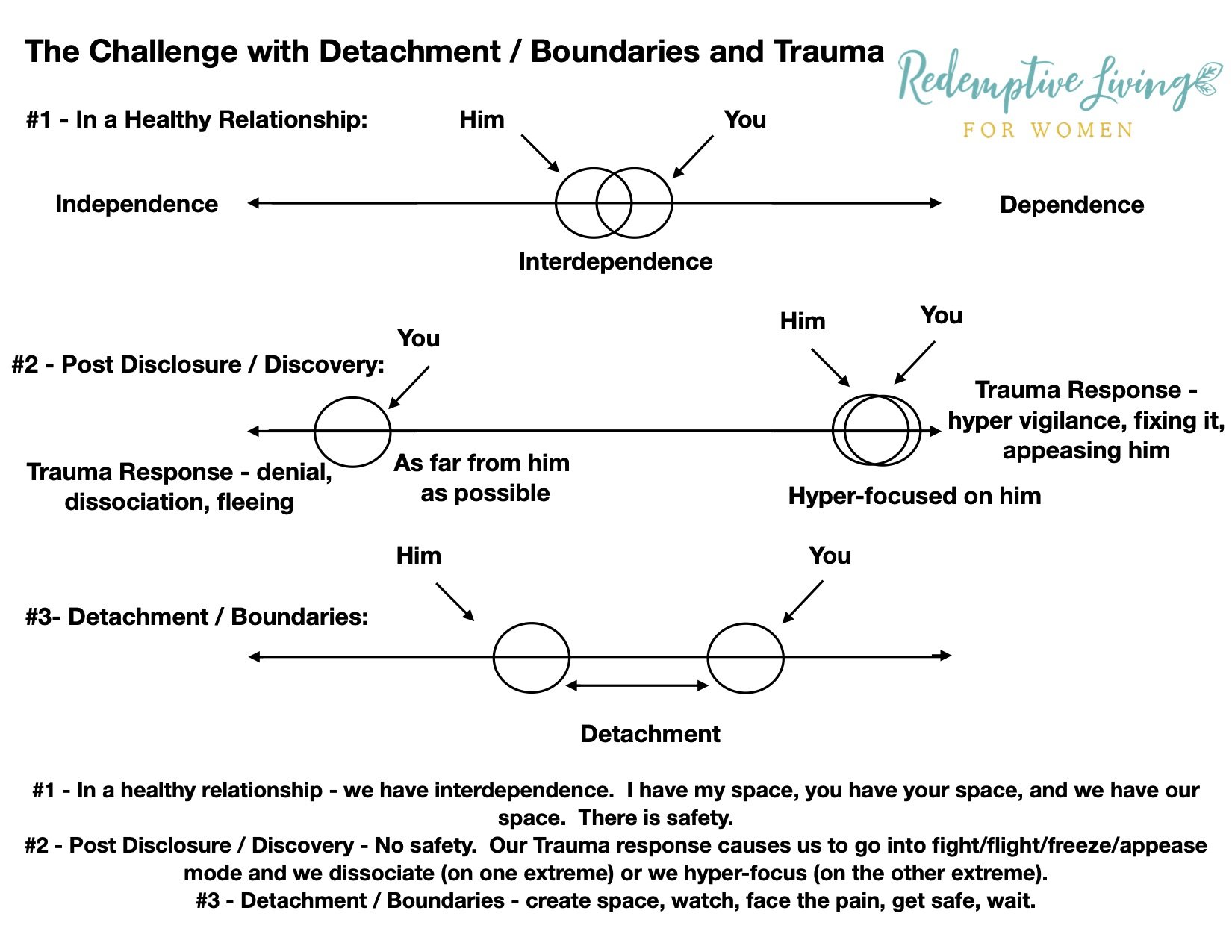
As you see from above, detachment is somewhere in the middle. We aren’t hyper focused on him and we also aren’t dissociated from ourselves or fleeing (see the middle image). We are connected to ourselves, grounded, feet firmly planted.
Bottom Line: We must understand and respect what is happening in our brains and bodies in order to GET to detachment. Practicing grounding exercises and other strategies to decrease those trauma symptoms is KEY.
With that said - Here are four things you can do to help you move toward detachment:
Practice Calming Your Brain
You can click on this video, which is apart of the Detachment Series I did toward the end of 2020 and the first four or so minutes of the video, I talk about some strategies to help calm our brains.
There are SO many strategies we can use - here are some other options:
rocking in a rocking chair has proven to be effective to calm our brains
practicing gratitude has also proven by research to be highly effective
walking in nature
laughter (and I always say - how WOULD we get through this if we didn’t have laughter, Jesus and the ability to use some bad words here and there!)
Know Your Why
Because detachment is so incredibly difficult, it’s important that we identify what our why is. This will keep us motivated when we feel like we can’t do it anymore (and especially when our amygdala is telling us we can’t do it anymore).
I see three main reasons that we need to detach - and they need to be apart of your why - to get safe, to gain protection and to also find clarity.
If we can keep those three things out in front of us as motivators - it will help us when we feel like we can’t detach anymore and we just want to jump into his hula-hoop and fix it or tell him what to do.
Accountability
Detachment is as hard as going on a diet. As some of you know that are in my Empowered Boundaries MasterClass this round, I had a bit of a Cheetos obsession that needed to come to a halt. I was using and abusing Cheetos to comfort myself (I also have a history of doing this with chocolate chip cookies) and I couldn’t stop eating them without accountability and support.

The same applies to detachment. You can’t do this alone. It’s imperative to develop your team around you so that you can detach and they can hold you accountable when everything in you wants to fight, flight, flee or appease.
What Is Your End Game - Name It
And finally, when you are detaching - NAME what it is you are needing to see. Maybe you are detaching to see if he will decide to step up and get some professional help and you aren’t going to be the one to drag him into it. Maybe you are detaching because you have told him you need a Full Disclosure and he is dragging his feet. Maybe it's because you need to feel safe.
Regardless, name what you are needing to see so that you can stay the course, as best as you can.
______________
My wintery Saturday morning came to an end, and it’s now Monday afternoon as I finish wrapping this up. I would so love to hear your detachment wins and your detachment losses. Share them in the comments below and as I am able, I will most definitely respond to you. We learn SO much from each other and I know firsthand that ladies get so much out of what you share here.
I'm also posting one of the videos from above on Instragram - so we can chat there as well.
Thanks, as always, for being here.
xo - Shelley
________________
Hey Gals! When I transitioned my old website to a new website in early 2026, I lost all my comments. These comments are precious to me and to so many of you. I am posting the comments here and please feel free to comment below if you have something you’d like to share. xoxo - Shelley
Kyleigh Clum said: So ironic this came through today. Current battle for me is detachment, I’m just not myself though, from everything. I need Healthier ways to detach and communicate. Disclosure was the hardest Thing I have ever faced, the healing is even harder..
My response: It's so so hard. Read the other articles and let me know if you have any questions at all. And know that you are NOT alone. xoxo - Shelley
Ann B said: This is just what I needed. I recently asked for a separation from my husband after I discovered he had relapsed without telling me and consequently broke several boundaries. The boundaries broken weren’t “horrific “ or frequent, but he lied about them. The diagram really helped me understand what is going on inside and why the detachment is a good thing. Still not sure how the clarity will come when my thoughts keep going all over the place. . . But I can already feel my body calming down being separated.
My response: Hi Ann - So great to hear from you here. Ah - the lies, I always say - the acting out, if it stops typically won't put the nail in the coffin for the women I work with. But continued lying?! Well, it frequently is a deal breaker.
The clarity DOES take time. I think it's important to name what you are needing clarity on. And while you are anchored in and pouring into yourself - I do believe it will come.
And grateful to hear your body is calming down! Thanks for all you shared, glad you are here. xoxo - Shelley
Heiti said: Thanks Shelley for your clear descriptions! Today, even after more than five years since the marriage ended, I needed detachment with my ex-, as I heard about life difficulties he has experienced through the holiday season. It was so clear to me how much his choosing the "easier" path back then (of partial recovery efforts and avoidance of risk and emotionally difficult work) has really created so much difficulty for him down the road. And, I'm ok...no, I'm really doing fine, great, grounded, thriving! And, I'm truly sad for him today. I still care for him deeply.
My response: Awe Heiti! I hear you in this. And holding that tension between sadness for him and realizing you are okay right where you are - that is good, deep work. Thank you for sharing your thoughts. You are SO loved! xoxo - Shelley
Suzanne said: I love this graphic and adding the appease part. It took a lot of work in recovery to not feel ashamed of how I first reacted when I was hyper focused trying to figure out what to do.. I have finally learned detach skill after working recovery for two and half years. So much still to learn but having my boundaries has made a big difference in my life. Thank you for your blog. I am forever grateful.
My response: yay Suzanne!!! Celebrating with you! And nope, nothing to be ashamed of - it's a natural response to trauma to go to the fight / flight / freeze / appease. Once we move out of that trauma brain, it really helps but it also takes a lot of work and intentionality. We are all on the journey together, figuring it out as we go! Thanks for being here! xoxo - Shelley
Janice B said: Detachemnt has been the absolute hardest thing for me in the last two months. I have given into My "fight" amygdala so many times in the last month, just being so angry. I am so thankful for this blog post and the links you provided. When you know better you do better.
My response: I hear you Janice!!! It's insanely hard! And love your last sentence: when you know better, you do better. YES!!! xoxo - Shelley
DJ Crossman said: Detachment... let's see 3 years since D-Day and I feel like I'm wiser and more practiced in this area, but one thing remains true about detachment, it's H-A-R-D! But here's what I'm realizing: It's OK to be ME, the real authentic me, warts and all. Secondly, I'm only responsible for myself therefore that means I'm not responsible for anyone else or their feelings. Lastly, I am a complete individual, with or without a husband. God and I make a great team. My purpose is to grow in who He created me to be and quite honestly, I feel like I've barely begun.
My response: DJ!!!!
Yes, girl, it's SOOOOO HARD!!! I heart your truths!!! SO good - I hope everyone reads them and then reads them again!!! You are a bright light!!! xoxo - Shelley
Kim C. said: I’ve tried many times to detach unsuccessfully. He’s always drawn to me when I detach. He will make all these promises and a few small changes then ultimately turn emotionally abusive again. I am tired and I am deeply hurt once again. Thank you for the detachment strategies. My only goal is to feel safe and protected at this point.
Nicole replied: Kim, my husband reacts in a similar fashion. I think "The kid" panics when its not getting the response he usually gets or fears consequences for his behavior.
Someone else farther into this process will have more wisdom than I do but just wanted you to know I see you and feel that hurt you shared.
My response: yes Kim - safe and protected, so important. I hope the strategies are helping. xoxo - Shelley
Rita said: I’m three months away from D day. Two months from the five day intensive for sexual addicted husbands and their wives five day intensive. Despite all the help there and the talking and talking, my husband has broken the agreed rules and boundaries we set up twice now. They were not huge things but at this stage of the game it doesn’t take huge things. I am extremely tired of this. Married for almost 10 years and just so much yeah sliding through the years until February 2021 and then believing lies until December 2021 and the real truth came out. I just want away from this mess. If you can’t trust someone with the small things how in the world can you trust them big things. Am I wrong to want to walk away
My response: Hi Rita - I definitely don't see how you are wrong for wanting to walk away. It sounds like you are needing protection and safety and so walking away would give you that. I encourage you to pray, pray, pray about your next steps. Don't rush anything - but also know that you are WORTH being pursued, loved, cherished and respected. Keep us posted on how you are doing. xoxo - Shelley
Nicole said: Hey Shelley!
When you are naming your why, do you communicate that with Jason? Any suggestions on how that should look if you do? Do we tell them the goal we need met in order to reengage fully or do we just say nope, not okay to act that way and let them sort?
I find I often know my why but then I struggle with running to E with it in a sense of urgency to be okay....definitely trauma fight and freeze mode activated regularly.
Which feels like, for him, it taps a "make a list of ways to get approval" or he withdraws (we've identified a few reasons why) and Im injured because he didn't engage my spoken need.
So I'm having trouble sorting whats a good talk about why im detaching and then actually detaching versus still hyper focusing on him to make me ok while giving him a step by step instead of watching and waiting.
Okay so I don't like to wait...that's in there too. It's so painful and scary right?
I actually had the thought, I need a hobby to distract me from raising my husband, so I got a puppy last month. Her training and needs keep me moving and less hyper focused on him. Which has been hard and healthy.
But I still struggle with when to engage and when to step back and allow space for him to do emotional weight lifting so we progess and not on my energy dollar.
It's like I'm always asking the question, how much pain do I allow us to be in before I rescue us.
My response: HI Nicole - This is SO insightful and I hope everyone that reads this blog post, reads your comment, too!!!
Great great questions - I think the key is to work toward detaching so that you get clarity and protection and also so that you do NOT do his work. I totally get wanting to rescue the two of you - and there is a gray area in there of communicating to him what you need (versus having him guessing what you need).
Bottom line - I think it's okay to share with him your why, what you need, but then make sure to step back to see if he is going to press in and help your heart heal.
I hope that helps and I am glad that you are here, Nicole. xoxo - Shelley